
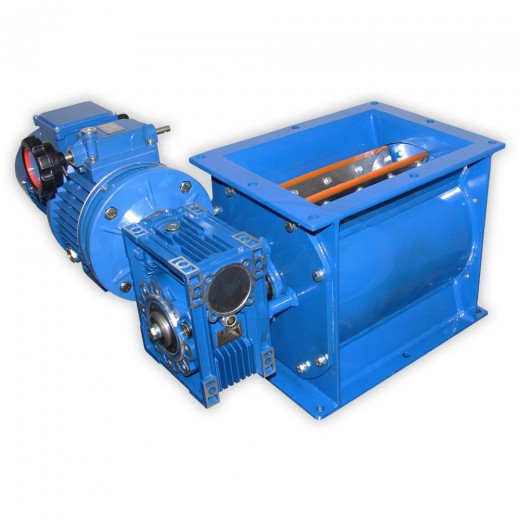
Sluice feeder Gal-JV
In Stock
This system is intended for discharging the collected dust from dust separators and operates in dust collecting devices where the pressure is higher than the atmospheric pressure. The air lock is intended for discharging the collected dust from dust separators (both centrifugal and filter), and operates in both discharge and injection systems. Its main purpose (work objective) is to remove the separated dust particles from the dust collecting equipment and prevent air suction.
Productivity: 9-36 m3/h
Review
Sluice feeders are mechanical devices designed to ensure uniform and continuous unloading of dry bulk materials
with different fractions (dusty, granular, fine-grained, etc.) from storage tanks such as bins and cyclones.
In addition to the discharge function, they can also be used as dosing devices, providing a controlled supply of material.
How the rotary valve works
The material is loaded into the rotary valve through the upper inlet, and the constantly rotating valve rotor moves the material
 to the lower part of the valve, where it is discharged through the external port.
Due to the minimal gap between the body and the rotor the valve does not allow air to pass through and reliably seals the process.
Advantages:
* High efficiency and reliability
* Easy to install and maintain
* Large selection of sizes and options
* Durability
* Tightness with pressures up to 0.9 bar
* An option to design equipment for operating conditions in ATEX 21 and ATEX 22 zones.
Sluice feeder is used:
Food industry: transportation of flour, sugar, grain and other bulk products.
Construction industry: supply of cement, sand, gypsum and other building mixtures.
Chemical industry: dosing of powdered reagents and other chemicals.
Metallurgical industry: transportation of ore, coke and other bulk materials.
Application:
* Aspiration filters
* Cyclones
* Bins/silos
* Separators
* Pneumatic transport
* Any other industrial equipment
The maximum surface moisture content of the material should not exceed 15%. Exceeding this indicator can lead to sticking of the material and disruption of the airlock valve.
To ensure optimal operation of the sluice gate, factors such as the angle of inclination of the hopper, the geometry of the outlet, as well as the properties
 of the material itself (fluidity, abrasiveness, etc.) must be taken into account. It is recommended that periodic maintenance of the feeder be carried out to
 prevent wear and ensure its reliable operation.
Array